The National Nostalgic Pro Stock Association was formed in 1994 by Dominic Durinzi and Jeff Johnson. At the time, Dominic was running an original Sox & Martin Hemi Colt, with racing partner Dave Heitz. Jeff had recently sold a rolling Billy Stepp Pro Stock Challenger and was in the process of restoring and documenting Don Carlton's forgotten “Wire Car”. During this time, relationships were developed with a large contingent of past and present Pro Stock participants, most notably of the Mopar contingent. The whereabouts of a vast majority of original cars were being determined and the NNPSA resulted in an effort to bring them together. National Trail Raceway in Columbus, Ohio became our home base and hosted several gatherings for these drag racing pioneers. In the mid nineties, these original cars fell into one of two categories; original cars that had been updated and were still racing in brackets or Super categories, or cars that were largely original but couldn't make it down the track. Due to our encouragements, several cars have not only been restored cosmetically, but are back to their original, and at times much greater, performance levels.
Fast forward to today and the nostalgia craze is in full swing. Jeff was instrumental in bringing Mopar Nostalgia Super Stock to the forefront of drag racing during the nineties, and new cars are still being built by racers every day. That rebirth is now continuing with later model, big tire Pro Stockers. A vast majority of the fully restored, documented cars have since escalated in value to the point where racing them is considered by some to be too great a risk. That's understandable, leaving the way for tribute or period correct cars to be built and raced. That's where the NNPSA once again comes in. We've refined our rules to encourage new builds and have secured facilities where enthusiasts can join together to relive the glory days of Pro Stock.
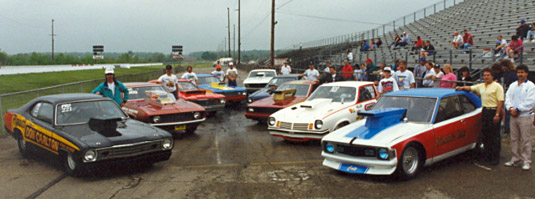
Photo from left to right: Jeff Johnson's Wire Car Duster, Bill Porterfield's Dickie Harrel Camaro; Ron Walker's Motown Missle Duster, Glenn Hicks' Sox & Martin Duster, Dave Lyal's Wild Thang Mustang, Parker and Ross' Pinto, Gary Phillips' Billy the Kid Arrow, Glenn Sharp's Jenkins Vega and Dominic Durinzi's Sox & Martin Colt. Photo by Richard E. Osborne.

Nostalgia Pro Stock Rules
1. Classes:
Open to vehicles formerly used in Pro Stock competition. Vehicles need not be authentic former Pro Stock cars. Clone cars acceptable. Tribute (period correct) cars acceptable. The following vehicles, and their model variations, are eligible to compete:
AMC:
1968-70 AMC AMX, 1968-70 AMC Javelin, 1970-78 AMC Gremlin, 1971-77 AMC Hornet, 1978-80 AMC Concord.
Chevrolet:
1967-69 Camaro, 1968-74 Nova, 1971-77 Vega, 1970-81 Camaro, 1975-80 Monza, 1981-88 Cavalier, 1982-92 Camaro
Buick:
1976-80 Skyhawk, 1981-87 Regal, 1982-89 Skyhawk, 1986-91 Skylark
Oldsmobile:
1975-80 Starfire, 1982-88 Cutlass, 1982-88 Firenza, 1984-91 Calais
Pontiac:
1967-73 Firebird, 1974-81 Firebird, 1976-80 Sunfire. 1982-87 Grand Prix, 1982-88 J2000, 1982-92 Firebird, 1985-91 Grand Am
Chrysler:
1981-83 Imperial
Dodge:
1968-72 Dart, 1970-74 Challenger, 1971-72 Demon, 1971-78 Colt, 1973-76 Dart Sport, 1976-80 Aspen, 1978-83 Challenger, 1978-83 Omni 024/Charger, 1984-93 Daytona
Plymouth:
1968-69 Barracuda, 1970-74 Barracuda, 1970-76 Duster, 1971-73 Cricket, 1976-80 Volare, 1976-80 Arrow, 1978-83 Horizon TC3/Turismo
Ford:
1969-73 Mustang, 1970-77 Maverick, 1971-79 Pinto, 1974-78 Mustang II, 1978-81 Fairmont, 1979-86 Mustang, 1982-88 EXP, 1983-88 Thunderbird
Mercury:
1968-70 Cougar, 1971-77 Comet, 1979-86 Capri
| All vehicles will race heads-up the quarter mile in one of the following established class indexes during eliminations: |
|
Mountain Motor Class 6.00-7.999 seconds. 1968-92 body, 500+ c.i., tube chassis, no weight minimum, Lenco required, (2) four barrel carbs required.
Class I 8.00 seconds. 1973-92 body, 500+ c.i., tube chassis, 2300# weight minimum, Lenco required, (2) four barrel carbs required.
Class II 8.50 seconds. 1973-92 body, SB or BB 572 c.i. max, tube chassis, 2300# weight minimum, any manual or Lenco transmission, (2) four barrel carbs required.
Class III 9.00 seconds. 1968-76 steel body shell, SB or BB 500 c.i. max, full chassis (back halved), 2300# weight minimum, any transmission, (2) four barrel carbs required.
Class IV 9.50 seconds. 1968-73 steel body shell, SB or BB 500 c.i. max, stock frame rails, 2300# weight minimum, any transmission, minimum (1) four barrel carb required.
|
Contestants will qualify based on running closest to their class index during time trials. There is no breakout rule in effect. Time trial pairings will be random at the discretion of the Staging Director but will usually pair similar era vehicles. Contestants may change their index any time during qualifying but will move to the bottom of the ladder. Three round eliminations will be "Chicago style." The two "closest to the index" winners from the first two rounds will meet in the final. Winner will be determined by running closest to their chosen index. .400 Pro Tree heads up start.
2. Ballast:
Weight must be installed in acceptable weight box, installed in trunk and attached to the frame or cross member. No liquid or loose ballast permitted.
3: Body:
a. Original style body shell must be retained. Bodies in white acceptable. Alterations permitted if retaining an overall stock appearance. Excessive weight reduction must not be visible. Fiberglass or other lightweight body panels are allowed.
b. Fender Splash Pans: Full inner panels are not required.
c. Firewall: Firewall may be moved rearward from stock location for engine installation. May be replaced with .028 inch steel or .040 inch aluminum.
d. Floors: May be replaced with .028 inch steel or .040 inch aluminum.
e. Frame: Back halved cars must use stock frame for car body used. Properly reinforced stepped frames permitted. Cross members may only be altered or relocated for engine or transmission clearance. Additional members may be added for roll cage installation. Tube chassis cars may use any properly reinforced frame.
f. Grille: Must be full production for make, model and year claimed. Covering in front of grille prohibited. Vehicle must retain stock head lamps, tail lamps and turn signals. Lights need not be operational. (Outlaw class not applicable.)
g. Hood/Scoop: Hood required in all classes. Hood may be modified to clear intake manifold. Era-correct (snorkel, lump) hood scoop required. Cowl induction scoops permitted on 1967-70 GM vehicles only. No aero scoops permitted.
h. Interior: Upholstered aftermarket front bucket type seats permitted (two required). Rear seat may be removed. Aftermarket replacement dashboard with aftermarket gauges allowed.
i. Paint: All cars must be painted in a style that reflects the era and paint colors available at the time. No primered vehicles. No for sale signs. Decals and lettering must appear vintage. Contingency decals may only represent products that were available during the era. All vehicles must run NNPSA decals.
j. Spoilers: OEM spoilers allowed. All rear spoilers other than those originally factory installed must not be more than four inches high and must be mounted behind the rear axle. Any rear spoiler must be integrated into the overall body design and be painted to match. No air dams. (Outlaw class not applicable.)
k. Windows: Windshield and windows must be of safety glass, Lexan, Plexiglass, or other shatter-proof material. Windows not required being operative.
l. Wheel Tubs: Wheel tubs of any size are allowed if legal wheels and tires are positioned in stock location relative to exterior body lines.
4. Brakes:
Brakes required on all four wheels. Aftermarket units allowed. Line-locks permitted.
5. Chassis:
Sub frames may be joined. Rear frame may be moved in or reconstructed for rear tire and wheel tub clearance. Roll cage required in all vehicles per NHRA General Regulation 4:11. Vehicles must have current NHRA chassis inspection sticker.
6. Drivetrain:
a. Any transmission with a maximum of five forward speeds and reverse allowed. Trans brake permitted with automatic transmission. Clutchless units accepted. Must remain in conventional location determined by engine used.
b. Rear End: Any rear end allowed, provided it was original equipment in an American production car. Aftermarket housings and axles, along with any gear ratio, are allowed.
c. Driveshaft Loop: Required.
7. Electrical:
Battery may be relocated. Electrically driven fans and water pumps permitted. Charging system not required.
8. Electronics:
a. The following electronics are not permitted; timed ignition interruption devices (stutter boxes), delay boxes, air and mechanical throttle stops, air shifters, dual line locks.
b. Computers and Data Recorders are allowed as long as they do not activate any function of the vehicle. Playback tachometers are allowed. No front wheel, hub or drive shaft pickups.
c. Electronic ignition components are permitted. Rpm limiters may be used for burnout and high side only, not as a launch device. 2 Step Module Selectors permitted with manual transmission only.
9. Engine:
a. Block: Restricted to original assembly line block or aftermarket replacement block. Must be same make as body used. Aluminum blocks allowed. Any displacement and internal modifications are allowed.
b. Carburetion: Limited to two four-barrel American automotive carburetors.
c. Cylinder Heads: Aluminum aftermarket heads allowed. Must retain original external overall appearance. Any internal modifications allowed.
d. Intake Manifold: In-line dual four tunnel ram required. Cross ram or under hood in-line permitted on 1967-69 vehicles. Cast or sheet metal intake permitted.
e. Oiling System: Dry sump systems permitted.
f. No power adders permitted.
10. Exhaust:
Open headers allowed.
11. Fuel:
Only gasoline fuel is permitted. Aftermarket fuel cells, electric fuel pumps and regulators allowed. Delete: No nitrous oxide. Add: E-85 is permitted. No nitrous oxide.
12. Ignition:
Any aftermarket ignition systems, wiring and electronic conversion kits are allowed. See "Electronics" for additional restrictions.
13. Radiator:
Any size radiator in stock location allowed. 16 oz. catch can required.
14. Safety:
a. Helmets: Must meet SNELL or SFI 31.2A or 41.2A specifications. All helmets must have the appropriate certification sticker affixed inside the helmet.
b. Protective Clothing: Jacket and pants must meet SFI Spec 3.2A/5.
c. Seat Belts: Required in all vehicles. Three inch safety harness must meet SFI Spec 16.1 and be less than two years old.
15. Steering:
Stock type steering in conventional location required. Rack and pinion steering permitted.
16. Suspension:
Aftermarket front suspension permitted. Front suspension limiters permitted. Sway bar optional. Solid bushings in rear suspension allowed. Leaf springs may be moved inboard for tire clearance. Ladder bars or four-link rear suspensions allowed. Wheelie bars allowed.
17. Tires:
Front tires must have a minimum tread width of 4.5 inches. Rear slicks are permitted and are limited to a maximum side wall designation of 14.5 inches of width by 33 inches of diameter. (Outlaw class not applicable.) Tire tread may not extend outside of fender. Maximum clearance between sidewall and body is 3 inches.
18. Wheelbase:
Era-accepted modifications permitted.
19. Wheels: Minimum 3.5 inches width required on the front. Any rear width is allowed as long as it fits under the stock wheel well opening. Era-correct front wheels are required (Ansen, Motor Wheel, Super Trick, etc.). Any rear wheel may be used for safety. Rear bead locks permitted.
20. Race Procedure: Cars will race a full 1/4 mile. All races in 2010 will be a Pro Tree .400 second heads up start. Across the line burnout(s) are permitted and encouraged. “Dry Hops” are encouraged. The use of rosin or “gold dust” will not be permitted due to time constraints and its lack of relevance to later model vehicles. Time trial and race schedule will be announced at the start of the event.
21. Rule Discrepancy: In the event of a rule discrepancy or if a subject is not covered herein, defer to the current NHRA rule book based on vehicle Elapsed Time.
22. Technical Inspection: The guidelines set within, and the safety rules set forth by NHRA are intended solely as the minimum acceptable standards. Safety is the responsibility of the participant. Prior to competition, all vehicles and drivers must pass the host facilityís tech inspection. NHRA safety regulations supersede any and all other regulations. The final interpretation of any and all rules concerning safety is solely at the discretion of the host facilityís Tech Director. NNPSA makes no representations, warranties, or assurances that a technical inspection will: detect every problem with a vehicle or a driverís personal equipment or clothing; detect every problem with rules compliance, or prevent injury, death or property damage. Non-safety related guidelines are set to ensure that vehicles represent the spirit of the class, not as a means of disqualification. First time participants may be given a one race grace period to correct any non-safety requirements. All concepts, rules and materials contained on this website and elsewhere, concerning Nostalgia Pro Stock, are copyright 2013 by Jeff Johnson and the National Nostalgic Pro Stock Association.
|

 Design & Production by ESP Web Design